If you haven't seen the work of Cape Town sculptor and designer Heath Nash, well by golly, it's time. Nash and his team of artisans craft beautiful light fixtures, housewares, and entire installations out of post consumer recycled goods like milk bottles, steel, and wire. The result is his aptly titled line Other People's Rubbish:
Thursday, January 28, 2010
Tuesday, January 26, 2010
Rainbow Raindrop Bathroom
We finished up the bathroom project for our clients last week (see our previous work for them here and here) and now we're ready to share our process and portfolio pictures of this super fun, and, of course, super colorful wall treatment project.
We decided on doing a painted burlap wall covering paired with a strie glaze trim. It took us about a week since we allowed drying time overnight between steps. If you're interested in trying it yourself, here's how it's done:
First, apply a wallpaper primer to the walls and let it dry overnight. Measure the walls that need to be covered with the burlap, then cut the fabric to size. Store the burlap carefully so it doesn't fray, or you will be annoyed with yourself.

Very thickly apply heavy duty, clay-based wallpaper paste to the wall's surface. It should be noisy and sound a little bit rude: squelch, squelch, squelch! Cut into the corners and edges first.

You want to get the burlap up on the wall when the wallpaper paste is at its freshest and wettest, so it's a good idea to work in small sections. You can use a roller on the larger areas.

We highly recommend getting a resident kitty to come supervise this next burlap part, 'cause it can get a little tricky.


Tuck the burlap up to the ceiling and into the corners first, then smooth it out towards the middle of the wall. Make sure you smooth out every square inch, you don't want any pockets of burlap that don't get stuck to the wall!

You'll need to make sure the seams on the burlap match up nicely with no overlap, otherwise you'll get a too-lumpy finish when it's plastered over later.

A flat-edged tool is a good thing to have on hand to tuck in the burlap without getting your hands too messy (although, full disclosure: they will get messy).

For holes and fixtures, like this satanic-looking space for a medicine cabinet, place the burlap straight over it and later cut the hole out. Avoid looking directly into its eyes.

This is what your completed burlap stage should look like. Make sure the kitty inspects it for quality (and by the way, plug up any holes and keep the door shut so no critters can get stuck!). Let the paste and burlap dry overnight.

Once it's all dry and you get the go ahead from the kitty, start plastering using a flat-edged tool. Just like when you prime and paint a normal wall, you should cut into the corners and edges with the plaster first.

Wrapping a rag around the handle of the tool can help prevent blisters. Help. There's no guarantee here. :)

This is what the plastered burlap looks like after drying overnight. Is that a scary hole, or what?!

Now you can treat the burlap covered wall just as you would any other surface you're going to paint. Use a good quality primer to cover the plaster.

While that's drying (usually a few hours--more or less depending on your climate and the season), take a break and entertain those kitties, will you?


Next, you can go ahead and paint the walls in the color that will serve as the base for your design. Before your final coat of paint, be sure to caulk in any seams, like where the chair rail meets the wall, any corners, and where the wall meets the ceiling. Before we begin the stenciling, we like to finish the trim.

Prime and paint the trim as you normally would, then let it dry. You can buy pre-mixed colored glazes, but we can't in good conscience recommend them! You'll get much better results when you mix your own glaze and tint.
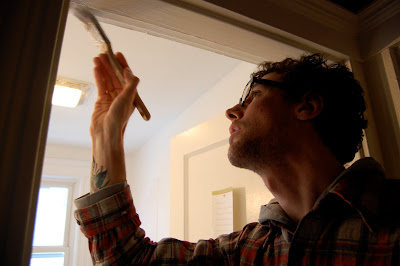

When the paint is dry, apply the glaze with a standard 2" painting brush.

Use a strie brush to get a nice lined effect; they're available in the Boston area at Johnson Paint Co. on Newbury Street, a favorite supplier of ours.

Working top to bottom, run the strie brush through the glaze to get a striped effect.

While the glaze is still wet, drag a piece of steel wool through it to create a specking texture as a finishing touch on the trim. There's a variety of grades of steel wool. Choose the grade according to effect you'd like to achieve; the rougher the steel wool, the rougher the texture.

Now you're ready to apply the water-based paint colors with the stencil design. Put a small amount of paint on a stencil brush (also available at Johnson Paint Co.), then work the brush into the pallet in a swirling motion, saturating the brush with paint without straight up dunking it. If there's too much paint on the brush, it will leak under the edge of the stencil.

Use painter's tape to put the stencil in place. Using the same swirling motion you used on the pallet, apply the paint onto the wall through the stencil.

You can remove the stencil immediately. Because of the texture of the burlap, you may find that some paint has leaked under the stencil. Don't panic, you can just touch it up later. I guess you can panic if you really want to, but you'll still just be touching it up later and you'll probably be tired from your panic attack.
True to Chroma Lab fashion, we used lots of bright colors, making the drops visually heavier at the top, and thinning them out near the bottom of the wall. Here's how it turned out:

One of our clocks fit perfectly into the color scheme, so we left it as a little surprise for our clients.

Their cute and colorful towels are by Marimekko (although that specific style is no longer available--too bad!).


Hope you like the pictures and how-to! We are considering beginning a series of instructional classes for wall treatment application and color mixing techniques. Would anyone in the Boston area be interested in that?
We decided on doing a painted burlap wall covering paired with a strie glaze trim. It took us about a week since we allowed drying time overnight between steps. If you're interested in trying it yourself, here's how it's done:
First, apply a wallpaper primer to the walls and let it dry overnight. Measure the walls that need to be covered with the burlap, then cut the fabric to size. Store the burlap carefully so it doesn't fray, or you will be annoyed with yourself.
Very thickly apply heavy duty, clay-based wallpaper paste to the wall's surface. It should be noisy and sound a little bit rude: squelch, squelch, squelch! Cut into the corners and edges first.
You want to get the burlap up on the wall when the wallpaper paste is at its freshest and wettest, so it's a good idea to work in small sections. You can use a roller on the larger areas.
We highly recommend getting a resident kitty to come supervise this next burlap part, 'cause it can get a little tricky.
Tuck the burlap up to the ceiling and into the corners first, then smooth it out towards the middle of the wall. Make sure you smooth out every square inch, you don't want any pockets of burlap that don't get stuck to the wall!
You'll need to make sure the seams on the burlap match up nicely with no overlap, otherwise you'll get a too-lumpy finish when it's plastered over later.
A flat-edged tool is a good thing to have on hand to tuck in the burlap without getting your hands too messy (although, full disclosure: they will get messy).
For holes and fixtures, like this satanic-looking space for a medicine cabinet, place the burlap straight over it and later cut the hole out. Avoid looking directly into its eyes.
This is what your completed burlap stage should look like. Make sure the kitty inspects it for quality (and by the way, plug up any holes and keep the door shut so no critters can get stuck!). Let the paste and burlap dry overnight.
Once it's all dry and you get the go ahead from the kitty, start plastering using a flat-edged tool. Just like when you prime and paint a normal wall, you should cut into the corners and edges with the plaster first.
Wrapping a rag around the handle of the tool can help prevent blisters. Help. There's no guarantee here. :)
This is what the plastered burlap looks like after drying overnight. Is that a scary hole, or what?!
Now you can treat the burlap covered wall just as you would any other surface you're going to paint. Use a good quality primer to cover the plaster.
While that's drying (usually a few hours--more or less depending on your climate and the season), take a break and entertain those kitties, will you?
Next, you can go ahead and paint the walls in the color that will serve as the base for your design. Before your final coat of paint, be sure to caulk in any seams, like where the chair rail meets the wall, any corners, and where the wall meets the ceiling. Before we begin the stenciling, we like to finish the trim.
Prime and paint the trim as you normally would, then let it dry. You can buy pre-mixed colored glazes, but we can't in good conscience recommend them! You'll get much better results when you mix your own glaze and tint.
When the paint is dry, apply the glaze with a standard 2" painting brush.
Use a strie brush to get a nice lined effect; they're available in the Boston area at Johnson Paint Co. on Newbury Street, a favorite supplier of ours.
Working top to bottom, run the strie brush through the glaze to get a striped effect.
While the glaze is still wet, drag a piece of steel wool through it to create a specking texture as a finishing touch on the trim. There's a variety of grades of steel wool. Choose the grade according to effect you'd like to achieve; the rougher the steel wool, the rougher the texture.
Now you're ready to apply the water-based paint colors with the stencil design. Put a small amount of paint on a stencil brush (also available at Johnson Paint Co.), then work the brush into the pallet in a swirling motion, saturating the brush with paint without straight up dunking it. If there's too much paint on the brush, it will leak under the edge of the stencil.
Use painter's tape to put the stencil in place. Using the same swirling motion you used on the pallet, apply the paint onto the wall through the stencil.
You can remove the stencil immediately. Because of the texture of the burlap, you may find that some paint has leaked under the stencil. Don't panic, you can just touch it up later. I guess you can panic if you really want to, but you'll still just be touching it up later and you'll probably be tired from your panic attack.
True to Chroma Lab fashion, we used lots of bright colors, making the drops visually heavier at the top, and thinning them out near the bottom of the wall. Here's how it turned out:

One of our clocks fit perfectly into the color scheme, so we left it as a little surprise for our clients.

Their cute and colorful towels are by Marimekko (although that specific style is no longer available--too bad!).


Hope you like the pictures and how-to! We are considering beginning a series of instructional classes for wall treatment application and color mixing techniques. Would anyone in the Boston area be interested in that?

Categories:
custom,
wall treatments
Monday, January 25, 2010
Spectacular Spectrum Cake Garland
So when you saw this beautiful Spectrum Cake Garland made of stamps on Poppytalk last week, did your eyes just about bug outta your head with delight?

Yeah, mine did, too. This idea appeals to me on many levels. Speaking as a rainbow junkie, former stamp collector, Anglophile, and champion cake eater, it's like Ms. Denise of d sharp had me in mind. She writes a blog and has many more fine things for parties and events in her store. d sharp, Chroma Lab salutes you!

Yeah, mine did, too. This idea appeals to me on many levels. Speaking as a rainbow junkie, former stamp collector, Anglophile, and champion cake eater, it's like Ms. Denise of d sharp had me in mind. She writes a blog and has many more fine things for parties and events in her store. d sharp, Chroma Lab salutes you!
And Our Feet Have Only Just Recovered
A year ago Tony and I finished running the Miami half marathon! (You can see pics from our race here.) We had a great time training for and running the race with our friends from Team Challenge while raising money for the Crohn's & Colitis Foundation.
I have Crohn's disease, and for quite some time, the ability to run any distance, let alone lead a normal life, was completely out of my reach. Being healthy enough to run the race and run our business every day since is something I celebrate every day! The CCFA has been a huge part of my success, so I encourage you to look into the Team Challenge program if you are interested in raising money for a great cause while accomplishing something amazing yourself.
I wish we'd had this when we were training though:
I have Crohn's disease, and for quite some time, the ability to run any distance, let alone lead a normal life, was completely out of my reach. Being healthy enough to run the race and run our business every day since is something I celebrate every day! The CCFA has been a huge part of my success, so I encourage you to look into the Team Challenge program if you are interested in raising money for a great cause while accomplishing something amazing yourself.
I wish we'd had this when we were training though:
Categories:
housewares
Friday, January 22, 2010
The Boston Shaker Wall Treatments
If you follow us on Twitter, you may have noticed us talking about working with Adam, the owner of The Boston Shaker, on wall treatments for his new store in Davis Square, Somerville.
The Boston Shaker is Boston's best (and only!) resource for quality cocktail supplies and instruction. Adam is a real expert on all things cocktail-related and is more than happy to chat with friends and customers about the history, composition, and culture of mixed drinks. Even if you're not a drinker (like me), Adam can recommend great resources for non-alcoholic concoctions. There are a lot of people who are excited to be a part of new The Boston Shaker store, and believe me, Adam is chomping at the bit to open. Once he's cleared all the permit hurdles, he'll be ready to offer up supplies, books, advice, and classes in the new space (for now, you can order online at his site).
We've been really happy to help Adam with his new venture and see how everything has come together over the last few months of prep and construction. We worked with both Adam and his interior designer, Christine Price Hamilton (you may have seen her exquisite Tesselights), to come up with colors and finishes that would create a contemporary yet traditionally minded atmosphere that's appropriate for the store's purpose. We're all wrapped up with the work now and thought you might like to see behind the scenes pictures of what went into the job:


On the back wall we applied a blue cross hatch glaze. After the glaze dried, we applied a dead flat varnish to achieve a matte finish.
We applied a gray faux bois plank finish with a dead flat varnish topcoat to match the sheen of the walls.
Almost ready for business!
The Boston Shaker is Boston's best (and only!) resource for quality cocktail supplies and instruction. Adam is a real expert on all things cocktail-related and is more than happy to chat with friends and customers about the history, composition, and culture of mixed drinks. Even if you're not a drinker (like me), Adam can recommend great resources for non-alcoholic concoctions. There are a lot of people who are excited to be a part of new The Boston Shaker store, and believe me, Adam is chomping at the bit to open. Once he's cleared all the permit hurdles, he'll be ready to offer up supplies, books, advice, and classes in the new space (for now, you can order online at his site).
We've been really happy to help Adam with his new venture and see how everything has come together over the last few months of prep and construction. We worked with both Adam and his interior designer, Christine Price Hamilton (you may have seen her exquisite Tesselights), to come up with colors and finishes that would create a contemporary yet traditionally minded atmosphere that's appropriate for the store's purpose. We're all wrapped up with the work now and thought you might like to see behind the scenes pictures of what went into the job:

We applied a gray faux bois plank finish with a dead flat varnish topcoat to match the sheen of the walls.
Almost ready for business!Not bad, huh? We'll be letting you know as soon as Adam can open up The Boston Shaker to the public--he is at the mercy of the City of Somerville (Free Adam!!!). He's having a grand opening party in February, so I hope you will come out to support another fine local business and see our handiwork! We will be posting some more polished photographs of the finished space along with some close up shots of the different finishes in the near future, so stay tuned!
Categories:
custom,
friends,
wall treatments
Subscribe to:
Posts (Atom)